A catalog's real complexity has little to do with how many SKUs it holds. A retailer with 5,000 products and market-specific pricing, compatibility rules, and warehouse-dependent stock can face a harder architecture problem than a competitor running 50,000 simple listings. Here's when headless commerce actually solves that, and when it just adds unnecessary layers.
A catalog with 50,000 SKUs is not necessarily complex. A catalog with 5,000 products can be far harder to operate when every product has market-specific pricing, compatibility rules, regulated information, warehouse-dependent availability, and customer-specific terms. That is where headless ecommerce for complex catalogs becomes a business architecture decision, not a front-end trend.
For retail, fashion, pharma, telecom, and B2B organizations, the central question is rarely whether a new storefront can look better. It is whether product data, stock, promotions, and orders can move reliably between the systems that already run the business. A headless approach can help, but only when the underlying data flow and ownership are clear.
What makes a catalog complex?
Complexity comes from rules and relationships, not product count alone. A fashion retailer may need color and size variants, seasonal collections, outlet pricing, bundles, loyalty benefits, and stock split across stores and fulfillment centers. A B2B distributor may need contract prices, account-specific assortments, technical documents, replacement parts, and approval workflows.
In these cases, a product page is assembled from more than a product name and image. It may combine information from a product information management system, ERP, warehouse management system, pricing service, content platform, and customer data source. That complexity is handled by enterprise ecommerce. Each system has a role, and the ecommerce platform must present a coherent result without creating conflicting copies of the same data.
The most costly problems usually appear at the edges: a product shown as available when it cannot ship, an ERP price that differs from the checkout price, or an attribute update that reaches the mobile app days after the website. These are operational failures, not design issues.
Why headless ecommerce can be the right model
In a traditional ecommerce setup, the storefront and commerce engine are closely connected. This can work well for a straightforward catalog and a standard customer journey. It becomes restrictive when the business needs several customer-facing experiences, such as a web store, mobile app, in-store kiosk, partner portal, or loyalty application, all using the same commerce logic.
Headless architecture separates the presentation layer from backend commerce services. The storefront communicates through APIs, while product, pricing, cart, checkout, and order capabilities remain available to different channels. That separation gives teams more control over the customer experience without forcing them to rebuild core business rules for each channel.
For complex catalogs, the value is practical. A product team can improve filtering and merchandising on the website without changing ERP integrations. A mobile team can create a faster category browsing experience using the same catalog data. Content editors can publish campaign pages without waiting for a release of the transaction system, provided the integration boundaries are designed well.
This flexibility also supports gradual modernization. Many established businesses cannot replace an ERP, warehouse system, and ecommerce platform in one project. A headless layer can create a controlled path forward, allowing a new storefront or app to be introduced while critical back-office systems remain in place.
Headless ecommerce for complex catalogs needs clear data ownership
A headless architecture does not simplify a messy catalog automatically. In fact, it can expose problems that were previously hidden inside one large platform. Before development begins, the team needs to define which system owns each critical piece of information.
The ERP may be the source of truth for base prices, invoices, and order status. A PIM may own product descriptions, attributes, media, and taxonomy. The warehouse system may own real-time stock and delivery constraints. The ecommerce layer may own web-only promotions, carts, and customer-facing product combinations. A CRM or loyalty platform may own segments, points, and personalized offers.
These decisions sound administrative, but they determine whether the platform remains reliable as the business changes. Without clear ownership, teams often solve urgent issues by storing the same field in multiple systems. Soon, no one can say which price or stock value is correct.
A useful design principle is to avoid treating every integration as a real-time request. Product content can often be synchronized or cached because a one-minute delay has little customer impact. Stock at checkout may need a real-time validation because selling unavailable inventory creates a direct operational cost. Thats why warehouse integration exists. The right approach depends on the data, the business risk, and the expected traffic.
Build around customer journeys, not APIs alone
API documentation is necessary, but it is not the starting point. First map the journeys that generate revenue or support costs: finding a compatible product, applying a loyalty reward, ordering from multiple warehouses, changing an order, returning an item, or checking an invoice.
Then test what each journey requires from the systems behind it. For example, a fast product listing page may need precomputed filters and cached availability indicators. Checkout needs price validation, stock reservation, payment processing, and a dependable way to send the final order to the ERP. These needs are different, so they should not be handled with one generic integration pattern.
The trade-offs leaders should plan for
Headless is not automatically a better choice. A tightly integrated ecommerce platform can be faster to launch, less expensive to operate initially, and perfectly suitable when the catalog, channels, and business rules are stable. For a company running one regional storefront with standard products and limited integration needs, extra architectural layers may create unnecessary work.
Headless introduces responsibility. Someone must maintain APIs, monitor synchronization jobs, manage security between services, and test what happens when a downstream system is unavailable. Front-end freedom also requires governance. If every channel interprets product rules differently, the business ends up with inconsistency rather than flexibility.
Budgeting should include more than the first release. Teams need observability, automated tests, load testing, documentation, deployment processes, and a support model after launch. These are not optional enterprise extras. They are what keep a high-traffic promotion from becoming a queue of failed orders and manual corrections.
Performance deserves particular attention. A storefront that makes several backend calls for every product card may work in a staging environment and struggle during a sale. Caching, search indexing, asynchronous processing, and carefully designed API responses are part of the product experience. Customers do not distinguish between a slow integration and a slow website.
A practical path to implementation
The safest approach is usually incremental. Start with an assessment of the current catalog, integrations, data quality, traffic patterns, and business priorities. Identify the journeys where the current architecture creates the most friction, whether that is slow category pages, inconsistent promotions, limited mobile capabilities, or costly manual order processing.
Next, establish a target data model and integration map. This should show source systems, data ownership, update frequency, failure handling, and the information each channel needs. It is also the right time to agree on product identifiers, variant rules, category structures, and how discontinued or temporarily unavailable products behave.
A first release should solve a meaningful problem while keeping risk contained. It might introduce a new headless storefront for one market, a mobile commerce experience for loyal customers, or a search and product discovery layer that improves a difficult catalog. The goal is to create a stable foundation that can expand, not to move every feature at once.
After release, operational feedback should guide the roadmap. Monitor API response times, failed synchronization events, search behavior, conversion points, and support requests. Business teams should be able to report catalog issues in language that developers can trace back to data flow or system behavior. This is where a long-term engineering partnership matters: the platform evolves as product lines, warehouses, and customer expectations change.
The architecture should match the business model
Headless ecommerce works best when it serves a clear business need: multiple sales channels, differentiated experiences, demanding integrations, or catalog logic that a standard storefront cannot manage cleanly. Its real advantage is not separation for its own sake. It is the ability to change one part of the digital product without destabilizing the rest.
For organizations with complex operations, the strongest result comes from treating ecommerce as a connected system rather than an isolated website. Clean modular code, well-defined data ownership, and ongoing testing give teams room to add new channels and rules without turning each change into a risky rebuild. That is the foundation worth investing in before the next catalog expansion or peak sales period arrives.
A growing retailer rarely outgrows its ecommerce platform because it needs a new homepage. The real pressure shows up in wrong stock counts, pricing rules nobody can manage anymore, and checkout that buckles the moment a campaign actually works. Here's when custom e development pays off, and why it's mostly integration work, not a rebuild from scratch.
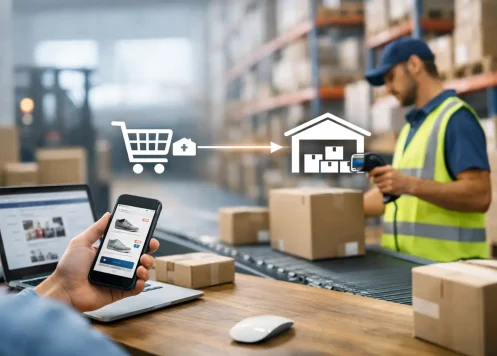
A customer sees "in stock," places an order, and expects a dispatch notification shortly after. That simple moment depends on ecommerce app warehouse integration working correctly, accurate inventory synchronization and ERP integration moving data between the storefront, warehouse, and delivery partners in real time. When it fails, the result is overselling, delayed order fulfillment, and a support ticket instead of a dispatch email. Here's what makes warehouse and retail order management reliable at scale.
A polished loyalty app means little if the points a customer earns in-store take hours to appear on their screen. The difference between programs that drive repeat sales and programs that generate support tickets is almost always the CRM integration behind the app: who owns the customer record, how fast systems sync, and what happens when a transaction fails. Here's how that architecture actually works.